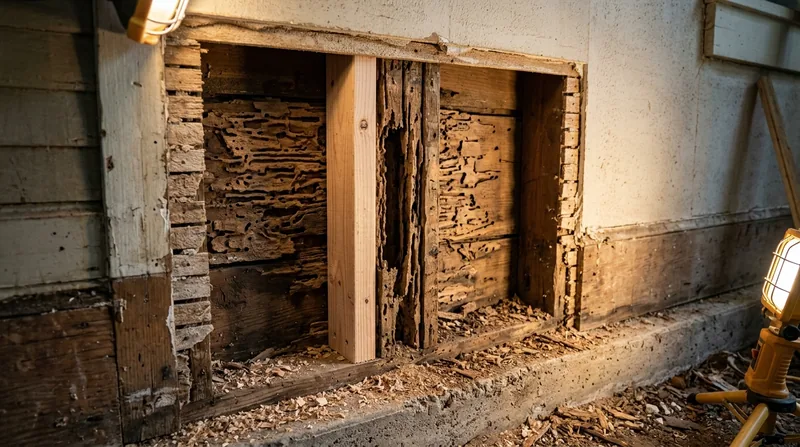




Termite Damage Repair in Austin means restoring structural wood after termites have eaten through studs, sill plates, floor joists, and trim across the city's older homes. Austin's hot, humid summers keep termite pressure high year-round, and the pest infestations that follow leave behind real damage to frame, subfloor, and exterior wood that won't repair itself. After your pest inspector leaves and the exterminator finishes treatment, the compromised wood stays in place, and that's where we come in. We replace termite-damaged studs, sills, rim joists, subfloor sections, and trim, working from your pest inspection report to restore full structural integrity. Whether you're in the historic bungalows of Hyde Park, the limestone-and-stone homes of Travis Heights, or the mid-century modern neighborhoods of Allandale, termite damage follows the same pattern: wood loss, weakened framing, and the need for honest replacement or repair. This page explains what the damage looks like, how we fix it, and what to expect in cost and timeline.
Why Termite Damage Repair Matters in Austin's Humid Climate
Termites thrive in Austin's subtropical humidity, and the older the home, the greater the exposure. Subterranean termites are the dominant species across Central Texas, and they work year-round in the warm months, eating cellulose from the inside out. By the time a homeowner spots signs, the damage is often deeper than it looks. Structural members like floor joists and sill plates lose load-carrying capacity, and exterior trim becomes brittle and prone to failure. The longer termite-damaged wood sits, the more secondary issues emerge: sagging floors, soft spots under carpet, or cracked drywall from frame settlement. Addressing the damage promptly prevents compounding repairs and protects your home's structural value.
- We replace termite-eaten floor joists and subfloor sections to restore load capacity and eliminate soft or bouncy floors.
- We remove and replace damaged sill plates and rim joists where termites have compromised the connection between foundation and frame.
- We restore exterior trim, fascia, and siding damaged by termite entry points and tunneling.
- We sister new studs alongside compromised wall framing when partial replacement is enough to restore strength.
- We document all damage and repairs to help you file an insurance claim if the infestation occurred during your policy period.
Each repair restores the wood's ability to carry load and weather the Central Texas climate without further deterioration.
Local context: Austin's termite season runs longest in the humid months from April through November, but activity continues year-round in heated homes. The limestone bedrock and creek-cut terrain of neighborhoods like Dripping Springs, Bee Cave, and West Lake Hills often bring moisture closer to wood framing, accelerating termite damage in those zones.
For more detail on wood damage assessment and repair strategy, see our Wood Rot and Dry Rot Repair page, which covers similar structural pathology and replacement methods.
How We Repair Termite Damage: Our Step-by-Step Process
We start with your pest inspection report and a site assessment to map the full extent of damage. Termite galleries often hide inside wood, so we probe suspected areas, document soft spots, and identify which members need replacement and which can be reinforced. We then plan the repair sequence to restore framing integrity while minimizing disruption to your home. In most cases, we work section by section, removing damaged wood, treating the area if needed, and installing new framing or sistered reinforcement.
- We conduct a detailed inspection and document all termite damage with photos and notes for your insurance file.
- We remove compromised wood, cutting back to sound material and exposing any hidden galleries or secondary damage.
- We install new framing, joists, studs, or sill plates of appropriate species and dimension to match existing structure.
- We sister new lumber alongside partially damaged members when the wood's remaining strength justifies reinforcement instead of full replacement.
- We restore trim, casing, and exterior finishes to seal the repair and match the original detail.
- We coordinate with your pest control contractor if further treatment is needed after framing work is complete.
The entire process prioritizes structural soundness and honest repair, never replacing wood that can be saved.
Example: A 1960s ranch home in Crestview had termite damage in the rim joist and the first 18 inches of floor joists along the north wall. We removed the damaged rim joist section, installed new pressure-treated lumber, sistered the joists with new Douglas fir stock, and sealed the rim with new blocking and caulk. The repair took 3 days and cost less than replacing the entire floor system.
For more on structural framing repair and reinforcement, see our Floor Joist and Subfloor Repair page.
Termite Damage Repair Methods: Replacement vs. Reinforcement
| Approach | Description | Best for |
|---|---|---|
| Full Replacement | Remove the entire compromised member and install new lumber of matching dimension and species. | Joists, studs, sill plates, and trim where damage exceeds 30% of the cross-section or spans more than half the member. |
| Sistering | Install a new member alongside a damaged one, bolting them together to share the load and restore strength. | Floor joists and studs where damage is localized and the remaining wood can support the structure during repair. |
| Scabbing | Attach a reinforcing patch of new lumber to the damaged face or end of a member using bolts and lag screws. | End damage in rim joists, sill plates, and beam ends where the core of the member is still sound. |
| Section Replacement | Cut out the damaged section of a long member and splice in new wood using plywood gussets or steel plates. | Long joists, beams, or studs where damage is concentrated in one zone and the rest of the member is strong. |
The choice depends on the extent of damage, the member's role in the structure, and the cost-benefit of each approach. We recommend the method that restores full strength at the lowest cost without compromising the frame.
Termite Damage Repair Cost in Austin: What to Expect
Termite Damage Repair costs in Austin typically start at $1,200 for small, localized repairs such as replacing a short section of rim joist or removing and reinforcing a single damaged stud. Larger jobs involving multiple joists, extensive subfloor replacement, or damage spanning several structural members run from $3,500 to $8,000 or more. The final cost depends on several concrete factors: the number and length of damaged members, access to the damage site, the species and dimension of replacement lumber, and whether the repair requires temporary shoring or bracing. A Victorian cottage in Clarksville with termite damage in the sill plate and first row of floor joists, for example, may cost $4,200 to $5,500 depending on whether the rim joist can be reinforced or must be fully replaced.
Getting 2 to 3 estimates from local carpenters is the best way to understand the scope and typical pricing for your home. We recommend always seeing the damage in person before committing to a price, because termite galleries can hide deeper damage that only shows up once wood is opened. Our estimate process is free, and we respond within 24 hours. See our pricing page for more detail on how we structure costs for different repair types.
Termite Damage Repair Near Me: What Austin Homeowners Should Know When Hiring a Carpenter
Hiring the right carpenter for termite damage repair is about more than price. Look for a contractor who listens to your pest report, explains what they see in the wood, and proposes honest repair rather than unnecessary replacement. Ask for references from recent termite repair jobs in your neighborhood, and check that the contractor is fully insured and carries workers' compensation coverage. If the repair involves structural members like floor joists or load-bearing studs, confirm whether a permit is required by the City of Austin Building Services Department. Some jobs in protected historic districts like Hyde Park or Clarksville may also involve HOA or heritage review, so clarify that upfront.
- Verify that the contractor is fully insured with general liability and workers' compensation coverage for your protection.
- Ask to see the contractor's work on similar termite damage repairs and speak with at least two recent clients.
- Confirm that the contractor can obtain any required permits and will coordinate with the City of Austin Building Services if structural work is involved.
- Get the estimate in writing with a clear scope of work, materials to be used, and timeline for completion.
- Understand that the contractor cannot guarantee your insurance claim will be approved, but can help document the damage and repair for submission.
A good local carpenter will take time to show you the damage, explain the repair strategy, and answer your questions before the work starts.
Contact us for a free estimate by calling (737) 387-5120 or visiting our contact page. We serve Austin, Round Rock, Cedar Park, Pflugerville, Leander, and surrounding areas throughout the greater Austin region.
Termite Damage Repair in Austin: Pricing Guide
| Service | Price | Details |
|---|---|---|
| Small termite damage repair | Starting at $1,200 | Localized rim joist or stud replacement, single member reinforcement, includes materials and labor for up to 8 hours on-site |
| Medium repair: subfloor or multiple joists | Starting at $3,500 | Replacement of 2 to 4 floor joists, subfloor section, or sill plate repair spanning 8 to 16 linear feet, labor and materials included |
| Large-scale structural termite damage | Starting at $6,500 | Extensive joist replacement, rim joist and sill plate overhaul, multiple structural members, or damage affecting 20+ linear feet of framing |
| Complex or hidden damage assessment | On estimate | Termite galleries often hide inside wood, requiring on-site inspection to identify full scope before an accurate price can be quoted |
| Travel and site access | Included | No separate mileage charge or call-out fee within Austin and surrounding service areas; included in estimate and repair pricing |
| Free estimate | No charge | Response within 24 hours, no obligation to book, full documentation and damage photos provided for insurance claim file |
Indicative pricing, the exact cost depends on square footage, finish, and site access. Free personalized estimate within 24h at (737) 387-5120.


